
Valeria Pineda
Data Scientist
github / kaggle / linkedin / researchgate
About me
I am a Senior Data Scientist with an M.Sc. in Engineering from Tecnológico de Monterrey, one of the most prestigious schools in Mexico. Throughout my career, I've developed multiple data science and optimization projects. If you would like to contact me reach out to me here or through my LinkedIn profile.

Education
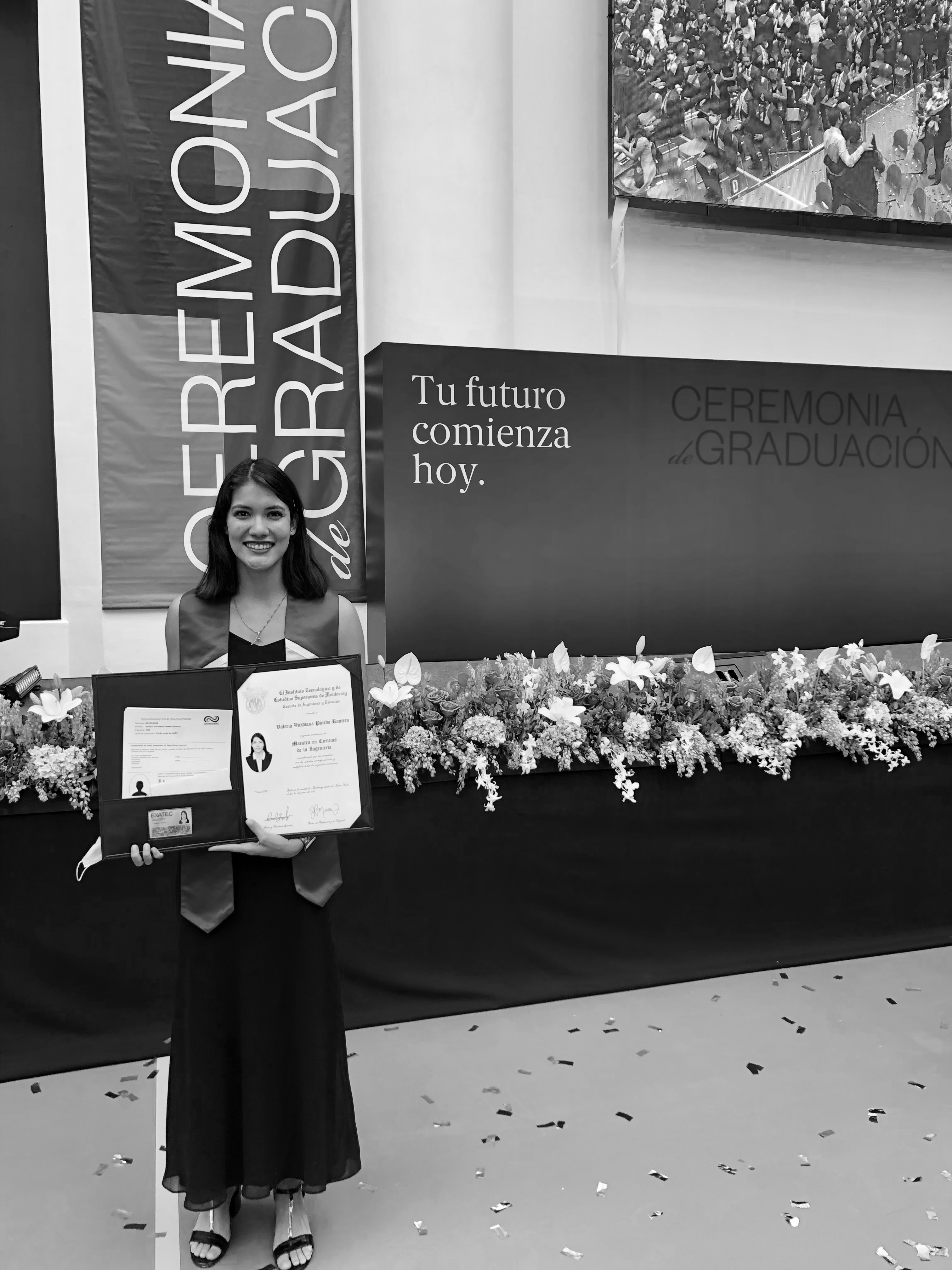
Master of Science in Engineering
August 2020 - June 2022
Activities
- Developed a series of projects focused on Data Science, Computer Science, and Optimization.
- Participated in the IX National Congress of the Mexican Society of Operations Research (CSMIO) with a project focused on generating storage assignment proposals through clustering techniques at warehouses with a Precedence-Constrained Order Picking Process.
Scholarships
- Obtained a full scholarship from Tecnológico de Monterrey in favor of coursing the Master of Science in Engineering.
- Attained the "Consejo Nacional de Ciencia y Tecnologia (CONACYT) Scholarship," financial support from Mexico's national science and technology organization.
Internships
Lean Manufacturing Program Teaching Assistant (August 2021 - December 2021).
B.S. Industrial and Systems Engineering
August 2016 - June 2020
Activities
Developed a series of assignments focused on implementing continual improvement, statistics, optimization, and logistics projects.
Scholarships
Obtainment of the Academic Talent Scholarship from Tecnológico de Monterrey, a full scholarship of 60% in favor of coursing college in this institution.
Internships
- Floor Walker at BMW Group (January 2019 - June 2019).
- Physical Logistics intern at BMW Group (February 2020 - June 2020).
International Experiences
- Universidad de Burgos (Burgos, Spain).
- University of Waterloo (Waterloo, Ontario, Canada).
Achievements
Awarded as one of the Best Averages of the generation of the August (2019) - December (2019) semester.

Skills
At Tecnológico de Monterrey, I've developed various Data Science, Optimization, and Statistics projects, which have helped me attain the following technical skills in Machine Learning.
In addition, I've also been capable of achieving the following coding skills.
Projects
In this section I present some of my projects.
Factors to improve online education, a study on the impact of COVID-19 on Delhi students
Due to the outbreak of COVID-19, people worldwide were asked to self-quarantine in their homes, resulting in the youth having to continue their education online. The lockdown and the effects of the pandemic had implications on students’ mental health, which presented as frustration, stress, and depression. The latter is not ideal for a healthy learning environment, as it leads to many coping mechanisms. This study analyzes a database that compiles the habits of 1182 individuals of different age groups from various educational institutes in Delhi-National Capital Region (NCR), India. Using this data, we implemented a machine learning classification model capable of predicting the students' enjoyment of an online class with an accuracy score of 89.54%. The findings were that students tend to decrease their probability of benefitting from online courses if they spend excessive time (>3-4 hours) studying, exercising, and on social media. On the other hand, there exists a higher probability that a student has a better online experience if they commonly perform creative activities like art or writing. Hence, families, schools and universities should enhance these activities for students and prevent them from spending excessive time on social media, exercising, or studying.

Google Mobility Analysis of Mexico during COVID-19
Analyzed trends, seasonality, and stationarity behaviors from the Google Mobility Report of Mexico, during COVID-19. Using the information from the analysis, we developed an Auto-Regressive model that could predict Workplace mobility for a week of November 2020 with an RMSE of 6.32 for the training and 13.44 in the test set. This quantity means that, on average, the predictions differ from the actual value by only 13 units.

Effect of adding omitted variables in Mediation and Moderation Analyses
Mediation and moderation analyses have been widely implemented in social sciences. Both techniques use regression analysis for modeling; consequently, these are subjected to assumptions of linearity, normality, constant variance, and independence of errors. When these assumptions are violated, models generate distorted results on the magnitude of effects and the causal relationships. To remediate the appearing inconsistencies, a common practice is the inclusion of variables that exert specific effects given their nature. In this project, a case study is analyzed based on the work developed by Mukuka et al. (2021), where we explore the results of adding moderators to their model. In this work, we compare the robustness and assumptions fulfillment from the original model with our proposed model. Results show that the second model increases the coefficient of determination by approximately 43.96% and decreases Root Mean Square Error (RMSE) and Mean Absolute Error (MAE) by 7.9 and 6.12 units, respectively. In addition, all regression analysis assumptions are met.


More Projects
Resume
Download resume.
Get in touch
© Untitled. All rights reserved. Design: HTML5 UP.